by BJ McManama
Artificial intelligence (Ai) has infiltrated our lives in commerce, social media, and personal communications. We can’t ignore the exponential increase in both promotion and opposition for building data centers across the country. Investors and builders are aggressively acquiring hundreds of acres of land as they move into rural and in economically depressed communities. Given the massive water use required for cooling hundreds, if not thousands, of computers running 24/7, the so-called advantages of using generative artificial intelligence are now viewed as a threat to water resources wherever these facilities are proposed.
A data center, in the not-so-distant past, typically meant a facility used for cloud computing, banking, social media, and internet search platforms. Platforms used to store our personal files, run business accounting software, and provide many other services connect us to remote locations where everything from art to balance sheets is produced.
These online services have been in use for several decades. However, the rush to dominate in a rapidly oversaturated cryptocurrency and Ai tech market with their unsustainable energy and water needs will continue to exacerbate environmental, economic, social, and cultural justice inequalities.
Limited or no access to fresh, non-toxic water in countless rural areas where these facilities are being planned remains ignored by bad actors with deep pockets. Despite the lack of available water for homes and businesses, these facilities will gobble up and pollute hundreds of millions of gallons of water weekly.
The water demands include components for these computational behemoths that require for example, “ultrapure” water needed for the microchips and servers to rinse impurities from silicon wafers. One chip manufacturing facility can use 10 million gallons of water per day. And similar volumes of water are needed to manufacture the multitude of components within these warehouse size facilities.
Communities rightfully ask questions like, where will the water and 100s of additional megawatts of power come from, and who will bear the burdens of scarcity and costs?
Fluence: Water’s Growing Importance in the Data Center Sector
These questions go unanswered, as developers dangle false promises like the proverbial magic carrot in their sales pitches to tribal, local, state, and federal lawmakers. In response to the pipe dream of economic prosperity, lawmakers and agencies tasked with protecting natural resources and the general well-being of their citizens are changing the laws and eliminating environmental reviews to speed permitting and construction. They are going further by codifying blanket prohibitions for local opposition. At one time, before tech’s stranglehold on politicians, communities could enact local zoning and regulations that would impose limits on water use, protect air quality, and reduce noise pollution.
AI Is Accelerating the Loss of Our Scarcest Natural Resource: Water
As inconvenient facts became widely known, it was necessary to enact laws that curtailed citizens’ opposition to data centers for any reason, but most importantly, the hyperscale data centers.
These laws also limit or completely eliminate citizens’ rights to decide whether to welcome or reject the siting of any extraction or highly polluting project. Communities are blocked from vital information in permit applications, citing proprietary information that can’t be released. Combined with the gutting of the National Environmental Protection Act, the support projects for these facilities has also been a direct assault on our right to protect our future access to water and a healthy environment. All of the legal skullduggery is the antithesis of states’ and landowners’ rights on which this country was founded. Yet the deceptively creative lawfare doesn’t stop there.
Tribes and state officials are also reducing and postponing property and other taxes for years in some cases to ensure these facilities will be built and operated within their jurisdictions. Resources that would otherwise be used for public services and replacing aging infrastructure result in significant deficits in local and state budgets.
It’s not only energy and water at issue. There are real threats to our rights and freedoms that are far more insidious and consequential.
Last week, news that the Ai company Anthropic, the creator of the chatbot Claude, which secured a multibillion-dollar contract with the Pentagon, had refused to grant uncontrolled access for autonomous battlefield operations and for widespread citizen surveillance.
Claude had already been deployed by the Pentagon and other national security agencies for mission-critical intelligence analysis, modeling and simulation, operational planning, cyber operations, and more.
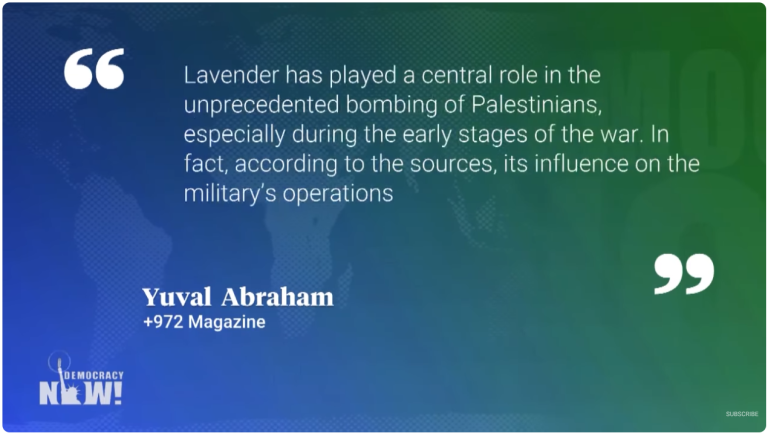
Anthropic’s systems were used in the raid to capture the president of Venezuela, despite violating the terms of use, which prohibit Claude from being used for violent ends, to develop weapons, or for surveillance. Similar Ai tech was used by the Israel Defense Force (IDF) to find, track, and target the people of Gaza during the protracted bombing attacks in the years after the Hamas raid in 2024.
Lavender & Where’s Daddy: How Israel Used AI to Form Kill Lists & Bomb Palestinians in Their Homes
The proliferation of video surveillance in the U.S. and across the world has provided Ai’s most valuable data to find, monitor, and detain or kill just about anyone, anywhere. We’ve become used to seeing cameras everywhere, despite initial opposition, citing the dangers of a future many feared and warned about. And there is no scarcity of warnings from political historians and pundits citing dystopian novels and movies meant to warn us of the dangers of an authoritarian or fascist ideology taking root in future administrations. The future is now!
U.S. Strikes in Middle East Use Anthropic, Hours After Trump Ban
As soon as Trump and Hegseth’s public temper tantrum and general order for all government agencies to cease using Anthropic’s tools because they were unpatriotic and untrustworthy, they quickly found a hitch in their plan. Apparently, detaching from or transitioning to another Ai system in a few days or even weeks is not a workable option. Therefore, it looks like OpenAI’s strategic position as the second choice and the first-in-line to do this regime’s bidding isn’t the end of the story just yet, as creators of ChatGPT are also backtracking on recent statements.
The Pentagon’s Claude Use in Iran Is a Reminder that Anthropic Never Objected to Military Use
That’s not to predict whether Anthropic can hold the line on the most unethical uses of generative or predictive autonomous intelligence. But it does open a gap in the time between now and whether OpenAI becomes Big Brother’s best friend, or we demand accountability and secure a complete ban on civilian surveillance and military command and control of autonomous war-fighting capabilities.
There are tribal and state governments that have or are in the first stages of placing moratoriums on new data centers permitting and construction, but we’re far from where we need to be.
Read more: Food & Water Watch – The Urgent Case Against Data Centers