
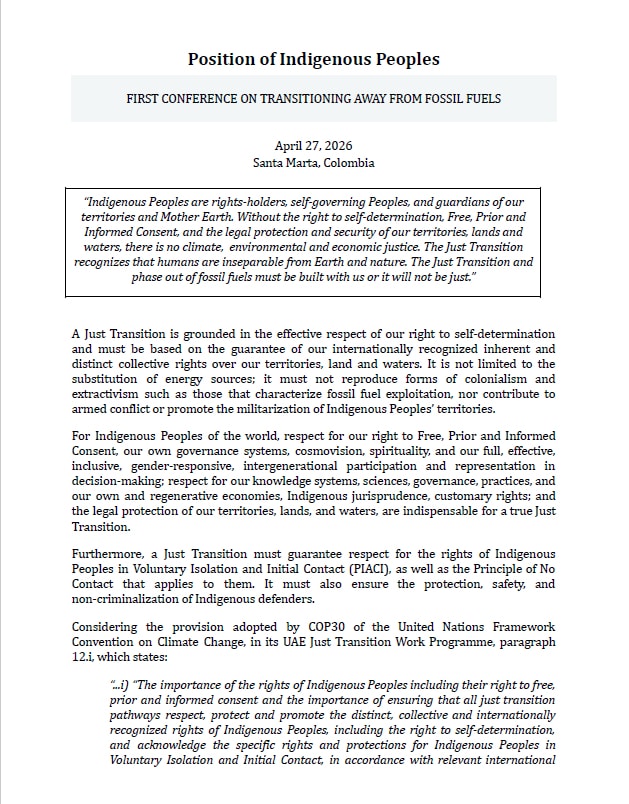
A Just Transition is grounded in the effective respect of our right to self-determination and must be based on the guarantee of our internationally recognized inherent and distinct collective rights over our territories, land and waters. It is not limited to the substitution of energy sources; it must not reproduce forms of colonialism and extractivism such as those that characterize fossil fuel exploitation, nor contribute to armed conflict or promote the militarization of Indigenous Peoples’ territories.
For Indigenous Peoples of the world, respect for our right to Free, Prior and Informed Consent, our own governance systems, cosmovision, spirituality, and our full, effective, inclusive, gender-responsive, intergenerational participation and representation in decision-making; respect for our knowledge systems, sciences, governance, practices, and our own and regenerative economies, Indigenous jurisprudence, customary rights; and the legal protection of our territories, lands, and waters, are indispensable for a true Just Transition.
Furthermore, a Just Transition must guarantee respect for the rights of Indigenous Peoples in Voluntary Isolation and Initial Contact (PIACI), as well as the Principle of No Contact that applies to them. It must also ensure the protection, safety, and non-criminalization of Indigenous defenders.
Considering the provision adopted by COP30 of the United Nations Framework Convention on Climate Change, in its UAE Just Transition Work Programme, paragraph 12.i, which states:
“…i) “The importance of the rights of Indigenous Peoples including their right to free, prior and informed consent and the importance of ensuring that all just transition pathways respect, protect and promote the distinct, collective and internationally recognized rights of Indigenous Peoples, including the right to self-determination, and acknowledge the specific rights and protections for Indigenous Peoples in Voluntary Isolation and Initial Contact, in accordance with relevant international… Click/Tap here to read more.
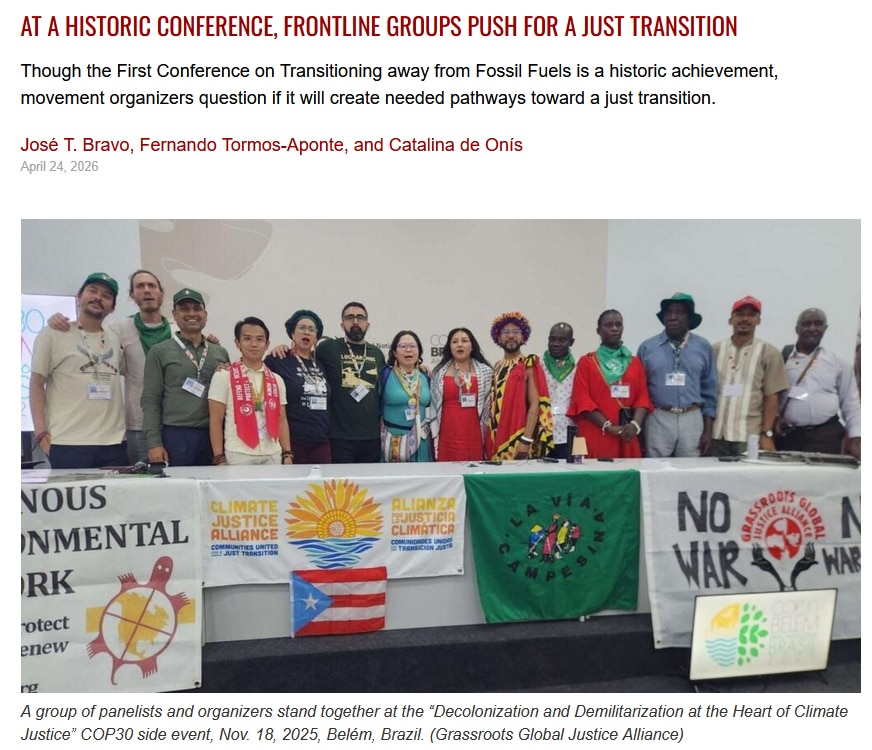
From April 24-29, 2026, people from across the globe will converge in Santa Marta, Colombia, for the First Conference on Transitioning away from Fossil Fuels. The conference is the first in 31 years of international climate negotiations dedicated specifically to transitioning away from fossil fuels, a focus that departs from the more limited scope of the United Nations Framework Convention on Climate Change (UNFCCC).
This convergence is a notable step forward. During the six-day event, at least 50 states will be involved, guided by co-hosts Colombia and the Netherlands. The conference follows the successful Peoples’ Summit in Belém, Brazil, a gathering last November in which social movements, labor unions and frontline workers, Afro-descendants, and Indigenous Peoples achieved broad alignment on just transition demands. The grassroots movement power-building generated during the summit continues to exert positive pressure, as a significant number of countries are finally signaling a willingness to address the elephant in the room: fossil fuels.
Even still, we ask: will the conversations and priorities that emerge from the Santa Marta meeting align with a just transition that responds to the urgency of this moment?
Indeed, this current juncture—characterized by multiple, overlapping crises of economic instability, militarism, and climate breakdown—must be approached with urgency, while ensuring no additional relational harm and striving to repair previous damages. The destructive use of fossil fuels as a weapon against people’s right to access reliable energy, which has spurred growing support for energy sovereignty, has made clear that a just transition is a matter of life and death. Social movements will not allow this historic gathering to serve as an opportunity for countries failing to meet basic Paris Agreement expectations to claim that they are climate champions just for showing up at the conference.
The conference in Santa Marta comes amidst mounting wars and occupations that have been openly driven by extractivist pursuits to control land and oil, dynamics that have profoundly impacted the region. Click/Tap here to read more.
In a world first, Colombia and the Netherlands are co-hosting a global conference on transitioning away from fossil fuels in Santa Marta, Colombia, on April 24–29.
Building on the momentum from COP30, this historic conference brings together committed countries, subnational governments and other stakeholders that recognize the need to implement a transition away from fossil fuels in a just, orderly, and equitable manner – in line with climate goals and the best available science by scaling up climate solutions (which contribute to economical growth, jobs, security and prosperity).
As the conference’s Official Global Media Partner, We Don’t Have Time, together with partners, aims to amplify key moment and voices from the conference to build momentum behind the implementation of a global transition away from fossil fuels.
Support the conference’s goal of phasing out fossil fuels through We Don’t Have Time’s campaign platform #MakeScienceGreatAgain.
Check out the official agenda of the First Conference on Transitioning Away from Fossil Fuels.