
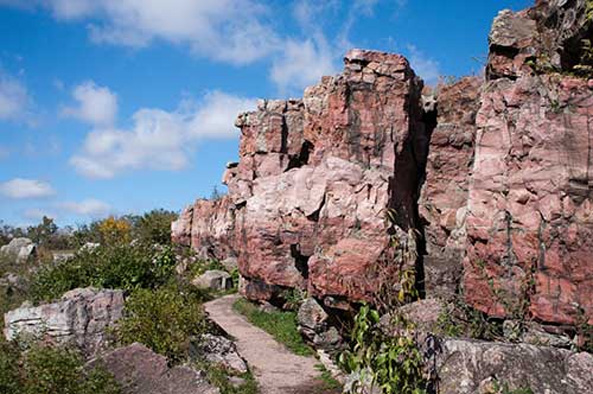
FLANDREAU, SD – The controversial Magellan Pipeline issue is heating up again. The pipeline, owned by OneOk of Tulsa, Oklahoma, had its construction permit rescinded by the Minnesota Public Utilities Commission on January 7, 2025. The proposed route would build a new pipeline within one mile of the Pipestone National Monument, a sacred site for Tribal Nations across the continent. The meeting was held on Thursday, hosted by the Wakpa Ipaksa Oyate, Flandreau Santee Sioux Tribe in Flandreau, South Dakota.
The Public Utilities Commission ordered Magellan to collaborate with the Minnesota Indian Affairs Council in choosing a culturally informed contractor for the required cultural survey. Almost immediately, Magellan violated that order and chose its own contractor unilaterally.
Tribal governments say the process has been plagued by inconsistency, departure from standard cultural surveying procedures, and failure to meet historical society guidelines. The current process appears designed to exclude known cultural sites within the project area.
The Red Stone Movement
The Red Stone Movement is composed of affected Tribal Governments, led by the Brave Heart Society and supported by grassroots members. Born out of necessity and guided by prayer, the Movement was established to oppose the pipeline near the sacred Pipestone National Monument. The Pipestone area is home to the sacred red stone used to create the canunpa, the sacred pipe. For generations, Tribal people who have been on this land for time immemorial have held this place in deep reverence. More than 35,000 public comments were submitted in November 2024, overwhelmingly in opposition. FINAL COMMENTS ARE DUE NOW! Anyone can comment, but we are encouraging Tribal Governments, Treaty Councils, and Grassroots Societies to submit comments and/or resolutions.
Voices from Tribal Nations
Dr. Alexis Archambault, Hydrologist with the Brave Heart Society, spoke to the significance of the surrounding hydrology and geology of the Pipestone landscape,, ““This specific pipestone (catlinite) is found nowhere else in the world. It took over a billion years for this unique geologic formation and sacred landscape to form.”
Echoing that urgency, ecologist Elijah Small with the Brave Heart Society warned, “There is no scientifically valid way to remove petroleum from pipestone. You wouldn’t drill under the Vatican. You wouldn’t flood Arlington Cemetery. You wouldn’t drill under the Holy Land. But they are doing that to us right now.”
Sara Childers, THPO of the Flandreau Santee Sioux Tribe, called for action: “Require a TCP evaluation of Pipestone National Monument and its sacred landscape before a route permit is issued. A tribal cultural landscape study must be commissioned from an Indian CRM firm with knowledge of the Pipestone quarry.”
She added, “Any tribe with cultural ties to the Pipestone area that did not participate in the surveys should formally intervene in the MPUC proceedings to ensure free, prior, and informed consent as required and established.”
Pete Lengkeek, President of the Crow Creek Sioux Tribe, spoke of the stone’s spiritual origins. “The White Buffalo Calf Woman came to us with the sacred red stone and the sacred teachings of how to live on this earth. That is why we exist today. They are threatening our lives, our existence, by threatening pipestone. I am one of those willing to lay my life down for them.”
This affects urban Native communities as well as those based on reservations. Crow Bellecourt, Cultural and History Coordinator of the Indigenous Protector Movement (IPM) based in South Minneapolis, connected the stone to healing. “We can only be strong through our ceremonies. Most of our ceremonies use that sacred stone. People are rebuilding. We have to protect that stone. It is very vital.”
Wayina Locke, Vice Chairwoman of Mukwa, offered solidarity. “As Water and Land Protectors, we support the protection of the red stone at Pipestone National Monument. This is for the sustainability of future generations who have not yet been born.”
A New Generation
This pipeline is coming back into the spotlight during the 10th anniversary of the NoDAPL protests at Standing Rock, North Dakota. Recently, a group of Oglala Lakota youth occupied a mining operation near the sacred site of Pe Sla in the Black Hills of South Dakota. The occupation, lasting only one week, ended abruptly after a judge issued a temporary restraining order. Surprisingly, the mining company Pete Lien and Sons withdrew its permit and made written promises to restore the land as it was.
Mark Tilsen, the National Pipeline Organizer with Indigenous Environmental Network, advised caution, “There are 170,000 Oceti Sakowin members who are not going to take a threat to one of our sacred sites lying down. Nobody wants another NoDAPL Pipeline fight in their backyard.”
What Comes Next
After a botched cultural survey conducted in violation of the PUC order, Tribal Nations are demanding that the MPUC deny any permit. More Tribes continue to have their voices heard and organizers eagerly await the opening of the public comment period.
Faith Spotted Eagle of the Brave Heart Society delivered a closing message for the Movement. “Pipestone is a sacred site that represents the very blood of our people and our future generations. We cannot allow the destruction of a spiritual gift brought by our holy one billions of years ago. Tribes from across Unci Maka pray with sacred pipestone. The survey submitted by Magellan OneOk is incomplete, inaccurate, and unacceptable.”